CEREMONY
Jewish Wedding Ceremony: Rituals and Order, Explained
The first time I stood under a chuppah, I was the non-rabbinic half of a co-officiated ceremony, and a cantor leaned over to me right before the procession and said, "You hold the.
The first time I stood under a chuppah, I was the non-rabbinic half of a co-officiated ceremony, and a cantor leaned over to me right before the procession and said, “You hold the room, I’ll hold the law.” That line stuck with me. It is the cleanest way I know to describe how a Jewish wedding actually works once you stop seeing it as a list of pretty customs.
I have spent years co-officiating interfaith ceremonies in New York, standing beside rabbis and cantors, blending Jewish ritual with a partner’s faith or with no faith at all. So I am not coming to you as a halachic authority. I am the officiant who has run the choreography, watched what moves guests to tears, and learned exactly which parts a couple can adapt and which parts need Jewish clergy.
Here is the thing most guides bury, and it is the one idea that makes everything else click into place.
A Jewish wedding ceremony is two ceremonies in one. There is kiddushin (the betrothal, with the ring and the Hebrew blessings) and nissuin (the marriage itself, with the seven blessings). These were once held up to a year apart and are now done back-to-back, with the reading of the ketubah as the deliberate seam between them (My Jewish Learning). Once you see that two-part spine, the chuppah, the ring, the circling, the seven blessings, and the glass all fall into an order that makes sense.
What is the chuppah and what does it symbolize?
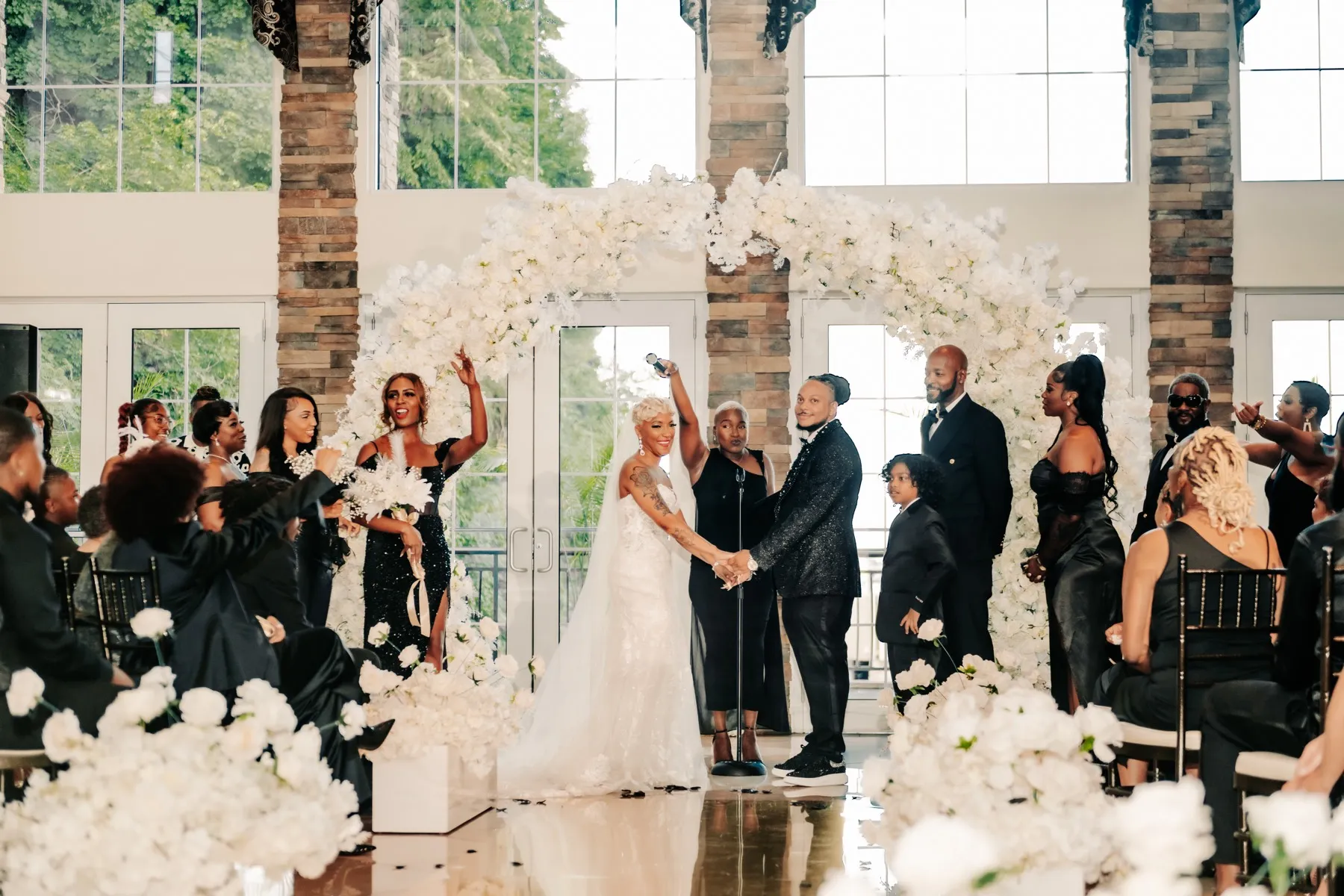
The chuppah is the canopy the couple stands under, open on all four sides. People reach for the symbolism right away, and it is genuinely lovely: it represents the home the couple is building together, open and welcoming, with no walls to keep loved ones out.
I have seen chuppot built from a tallit (a prayer shawl) held aloft on poles by four people who matter to the couple. I have seen them heavy with flowers, and I have seen one made from a quilt a grandmother stitched by hand. The structure is fixed. What you cover it with is yours.
For interfaith couples, this is usually the easiest element to keep. The chuppah carries without a single word of Hebrew, because the idea of a shared, open home belongs to everyone. When I co-officiate, the chuppah is often the first thing we agree on and the last thing anyone debates.
What is the ketubah, and who actually signs it?
The ketubah is the Jewish marriage contract, traditionally written in Aramaic, that spells out a husband’s obligations to his wife. It is signed before the public ceremony, usually during the kabbalat panim (the pre-ceremony gatherings), and it is read aloud under the chuppah as the hinge between the two halves of the ceremony.
Now the planning trap, and I see couples walk into it constantly. The traditional witnesses (the edim) must be two observant Jewish adults who are not related to the couple and not the officiant (Chabad.org). So the brother of the bride, the best friend who has been there since kindergarten, the parent who raised you: in an Orthodox or Conservative ceremony, none of them can sign. Couples assume their closest people will witness, and then learn at the worst possible moment that they cannot.
Reform practice opens this up considerably. Witnesses may be any gender, 13 and older, and some clergy welcome non-Jewish witnesses. Interfaith couples typically use an egalitarian or values-based ketubah that reads as a statement of shared commitment rather than the binding Aramaic original.
Why does the bride circle the groom seven times?
This one surprises people because it looks so ceremonial and the reasons behind it are so layered. In Ashkenazi tradition, the bride circles the groom seven times (the hakafot), a number tied to the seven days of creation and to building a new family world with your partner at its center. One reading connects it to the seven circuits the Israelites made around Jericho.
Here is where modern couples get creative, and I love it. A common egalitarian adaptation is three circles each plus one together, totaling seven, or each partner circling the other an equal number of times (18Doors). It keeps the ritual intact while saying, plainly, that this is a marriage of equals. When I work with two grooms or two brides, this is almost always how we handle it.
The betrothal: the ring and the Hebrew blessings
This is the legal heart of the whole thing, the part I cannot do alone, and the part interfaith couples most need to understand.
In kiddushin, the groom places a ring on the bride’s finger and recites a Hebrew formula declaring her betrothed to him by Jewish law. The blessings over wine are recited. This is the moment that, in traditional practice, actually effects the marriage, and it is meant to be led by Jewish clergy or a knowledgeable Jewish officiant.
There is also a detail about the ring that almost no one knows, and it is wonderfully practical. The ring must be the groom’s own property, a plain solid band of metal with no gemstones and no holes (Chabad.org). The reason has nothing to do with romance. It is about contracts. The ring’s value has to be clearly knowable, and a stone makes value easy to fake, which could theoretically undermine the validity of the marriage. The unbroken-circle symbolism came later. At the start, this was a legal precaution.
What are the seven blessings (sheva brachot)?
After the ketubah is read, the ceremony crosses into nissuin, and this is where the seven blessings live. The sheva brachot are seven blessings recited or chanted over a cup of wine. They move from praising creation all the way to the specific joy of these two people, and they are often shared out among honored family and friends rather than read only by the officiant.
In interfaith ceremonies, this is the ritual I most love to reimagine. We keep the structure of seven and turn them into seven personal blessings spoken by loved ones from both families: a blessing for friendship, for laughter, for compassion, for family, for resilience. Each person steps up, offers their wish, and steps back. The room fills with voices instead of one. I once watched a bride’s Catholic grandmother and a groom’s Jewish uncle offer back-to-back blessings, and for a moment they felt like one family with one history.
If you want a template for how this flows out loud, here is one I have used and adapted many times.
CEREMONY SCRIPT
Seven Blessings, reimagined for a shared ceremony
Officiant (introducing):
“In Jewish tradition, the couple receives seven blessings, the sheva brachot. Tonight, instead of one voice, we have asked seven people who love you to each offer a blessing for the marriage you are beginning. Listen closely. These are the hopes of everyone who raised you here.”
(The first reader steps forward.)
First blessing, for joy:
“May your home always hold laughter. May you find, even on the hard days, one small reason to smile at each other.”
Second blessing, for partnership:
“May you carry the heavy things together, and never assume the other one has it handled alone.”
Third blessing, for friendship:
“May you stay curious about each other. May you still be telling each other stories forty years from now.”
Fourth blessing, for resilience:
“May you weather what comes, and come out the other side holding hands.”
Fifth blessing, for family:
“May your two families, gathered here, become one. May this be the start of holidays shared and tables joined.”
Sixth blessing, for compassion:
“May you forgive quickly, apologize first, and never go to sleep on a closed door.”
Seventh blessing, for love:
“And may your love deepen with every year, richer at fifty than it is right now, under this canopy, on this night.”
(The officiant gathers the moment back.)
Officiant:
“Seven blessings, from seven hearts. May they all come true.”
If you want a full, copy-ready ceremony you can shape from start to finish, I keep a free sample ceremony script you can pull from for the welcome, vows, and ring exchange that wrap around a moment like this.
What does breaking the glass mean?
Almost everyone has seen this, even people who have never been to a Jewish wedding. The groom (or both partners) stamps on a glass, it shatters, the crowd shouts Mazel Tov, and the ceremony breaks open into celebration.
The glass is wrapped in cloth or a napkin so no one gets cut, and the meaning underneath it is sober. Even at the height of joy, you remember the destruction of the Temple in Jerusalem (Chabad.org). Jewish memory holds loss inside its happiest moment, on purpose. It is also widely read as marking the irreversibility of the step you just took.
Reform and egalitarian couples have opened this up. Often both partners break a glass now, or the act gets reinterpreted as breaking what came before to seal what comes next. Whatever the framing, it is the single most reliable closer I know. It works at the end of almost any ceremony, which is exactly why interfaith couples reach for it so often.
Two parts of the day guests almost always miss
Two rituals happen offstage, and because guests do not see them, they get treated as afterthoughts. They deserve better.
The first is the badeken, the veiling. Before the public ceremony, the groom veils the bride himself. The custom traces back to the story of Jacob, who was tricked into marrying Leah instead of her sister Rachel (Wikipedia), so the groom looks at his bride and confirms, with his own eyes, that he is marrying the right person. In practice it is often the most emotional moment of the entire day, more raw than anything that happens under the chuppah, and most guests are still finding their seats while it happens.
The second is yichud, the seclusion. Right after the ceremony, the couple slips away alone for roughly 8 to 20 minutes (Wikipedia). In Orthodox practice this carries real halachic weight; it helps effect the marriage. Couples who have been fasting traditionally break their fast here, alone, before they face the crowd. Guests usually assume the couple wandered off for photos. They did not. The disappearing is the point.
What is the order, and how long does it run?
Here is the full sequence of a traditional Jewish wedding day, in order (Chabad.org):
- Kabbalat panim: separate pre-ceremony receptions, often where the ketubah is signed
- Badeken: the groom veils the bride
- Procession to the chuppah
- Circling: the hakafot
- Betrothal (kiddushin): the blessings, the ring, the Hebrew formula
- Reading of the ketubah: the bridge
- The seven blessings (sheva brachot): the heart of nissuin
- Breaking the glass
- Yichud: the couple’s private seclusion
Length tracks observance, and I think couples deserve an honest number. Orthodox and Conservative ceremonies, carrying the full Hebrew liturgy, often run around an hour or more. Reform and Reconstructionist ceremonies commonly run 30 minutes to an hour (Mitzuyan Kosher Catering). Interfaith ceremonies usually run shorter, because they keep the rituals that resonate (chuppah, ring, seven blessings, glass) and trim the longer liturgical stretches.
If the spine of a Jewish ceremony made the rest make sense to you, the same is true of the standard order of a wedding ceremony more broadly. Every tradition has a logic underneath the sequence.
Do you need a rabbi? The honest answer for interfaith couples
This is the question that actually controls your planning, and most guides dodge it.
For a fully traditional, halachically valid Jewish wedding, the betrothal core needs Jewish clergy or a knowledgeable Jewish officiant. The Hebrew ring formula, the betrothal blessings, the kosher witnesses on the ketubah: that is the part with Jewish-law weight, and it is not something a secular officiant can validly perform.
Now the part nobody warns interfaith couples about. Most Orthodox and Conservative rabbis, and many Reform ones, will not officiate interfaith weddings at all, and among those who do, most decline to co-officiate alongside non-Jewish clergy (My Jewish Learning). So if you are marrying across faiths, finding clergy is not a quick phone call. You are looking specifically for a rabbi or cantor who does this work, and there are wonderful ones who do.
The other path is the co-officiant arrangement, which is most of what I run. Here is the real division of labor, the choreography I have actually stood inside. A rabbi or cantor carries the kiddushin: the Hebrew, the ring formula, the binding core. I carry the welcome, the couple’s personal vows, the reimagined seven blessings, and the breaking of the glass. We work out in advance who stands where and exactly where the Hebrew hands off to English, so it reads as one ceremony with two voices, never two ceremonies stapled together.
If you are building a wedding that blends two faiths, I wrote a fuller piece on how to plan an interfaith ceremony that honors both traditions without flattening either one. And if you are curious how Jewish ritual sits alongside the customs of other faiths, this fits inside our larger look at wedding traditions and where they come from, the kind of ordered structure interfaith couples love to draw from.
Adapting these rituals for your own ceremony
If you are an interfaith couple deciding what to keep, here is how I think about it after running dozens of these.
The chuppah, the breaking of the glass, and the seven blessings move easily across faiths. The chuppah is a shared home anyone can stand under. The glass closes a ceremony with a sound everyone feels in their chest. The seven blessings become personal wishes from the people who raised you, and they belong to both families at once.
The element to handle with care is the kiddushin, because the Hebrew betrothal formula is specifically a Jewish-law act. You either keep it intact with Jewish clergy, or you adapt it into a unity moment that honors both partners equally rather than performing a ritual that isn’t yours to perform.
This is exactly the kind of thinking that goes into The Couple’s Ceremony Kit. I built it for couples who want to shape a meaningful ceremony themselves, with structure, real script language, and guidance on which rituals to keep, swap, or reinvent, so you walk into your wedding day knowing your ceremony is yours and that it holds together. If you are blending traditions, it gives you the bones to build on.
Frequently asked questions
Do you need a rabbi for a Jewish wedding?
For a fully traditional, halachically valid Jewish wedding, yes. The betrothal core (the Hebrew ring formula, the blessings, and kosher witnesses on the ketubah) is meant to be led by Jewish clergy or a knowledgeable Jewish officiant. For an interfaith or Jewish-inspired ceremony, couples can find a rabbi or cantor who officiates interfaith weddings, or use a co-officiant where clergy carries the Jewish-law parts and a secular or other-faith officiant holds the welcome, vows, and shared blessings.
What is the order of a Jewish wedding ceremony?
A traditional Jewish wedding day runs: kabbalat panim (pre-ceremony gatherings, often where the ketubah is signed), badeken (the groom veils the bride), the chuppah procession, circling, the betrothal blessings and ring, the reading of the ketubah, the seven blessings, the breaking of the glass, and yichud (the couple’s private seclusion). The ketubah reading is the hinge between betrothal and marriage.
What does breaking the glass at a Jewish wedding mean?
The glass, wrapped in cloth for safety, is shattered underfoot to remember the destruction of the Temple in Jerusalem, a reminder that even at peak joy Jewish memory holds loss. It is also read today as marking the irreversibility of the moment. Many egalitarian couples now have both partners break a glass, and the crowd’s shout of Mazel Tov follows.
How long is a Jewish wedding ceremony?
It depends on the tradition. Orthodox and Conservative ceremonies, with the full Hebrew liturgy, often run around an hour or more. Reform and Reconstructionist ceremonies tend to run 30 minutes to an hour. Interfaith ceremonies usually run shorter because they keep the most resonant rituals and trim the longer liturgical sections.
What is the ketubah and who signs it?
The ketubah is the Jewish marriage document, traditionally written in Aramaic, spelling out the husband’s obligations to his wife. It is signed before the ceremony by two kosher witnesses: observant Jewish adults who are not related to the couple and not the officiant. It is separate from the civil license. Reform couples often use egalitarian or values-based ketubot with a wider range of witnesses.
Whatever you keep and whatever you adapt, build it on purpose. A Jewish wedding has survived for centuries because every piece of it means something, and the couples I remember most are the ones who knew exactly why each ritual was there before they decided to keep it.
KEEP READING
CEREMONY
Caribbean Wedding Traditions Worth Keeping
A couple sat in my office in Crown Heights, both second-generation, one side Guyanese and one side Trinidadian, and the bride said, "We want it to feel Caribbean, but we don't.
READ →
CEREMONY
What Is a Unity Ceremony? The Complete Guide
What a unity ceremony is, where it fits in your wedding, and how to choose the right ritual, from an officiant who's performed them at 300+ weddings.
READ →
CEREMONY
African Wedding Traditions, Explained With Respect
A few years ago I stood at the front of a Brooklyn ceremony while the bride's grandfather poured palm wine onto the floor of a rented loft and called the names of three people who.
READ →WANT THE DONE-FOR-YOU VERSION?
The Ceremony Kit.
Five full ceremony scripts, sixteen unity rituals, vow workbook, and the bonuses Robyn uses with her own couples.
- Five full ceremony scripts you can use as-is
- Sixteen unity rituals with scripts and how-tos
- Vow workbook for both partners
Used by hundreds of couples. Written by Robyn over 300+ ceremonies.