
VOWS
What to Promise in Your Wedding Vows: How Many, and 40 You Can Make
How many promises to make in your vows and why, the difference between a promise and a compliment, forty promises to adapt, six lines to lead into them, and the ones to cut.
You have the story, maybe the night the power went out in your first apartment, and you know roughly how you want to end. It’s the middle that has you stuck: one line that says “I promise to love you forever,” a cursor blinking after it, and the feeling that every guest has heard that sentence before.
Start with three to six promises, and make each one something your partner could watch you do, like coming back to finish an argument after twenty minutes apart. Take them from different parts of your life, with one for an ordinary day, one for a hard day, one about growing or family, and at most one funny one. Lead into them with a single plain sentence, and agree on the number with your partner so your two sets match.
Below you’ll find a way to choose your number, forty wedding vow promises you can adapt tonight, six lines that get you into them, and the ones I’d cut.
How many promises should be in wedding vows?
Start with three to six. That’s the range used in the Couple’s Ceremony Kit, not a rule your vows have to obey. It gives you room to cover a few different parts of your life without turning the middle into a checklist.
For a one-to-two-minute draft, 120 to 240 words is a useful starting budget if you plan around 120 words a minute. That pace is a planning assumption, not a prediction of how you’ll sound with a microphone. Time your own draft aloud, and leave room for pauses.
Within that draft, you might give the promises 60 to 120 words. At the same assumed pace, that’s about 30 to 60 seconds before extra pauses. Three longer promises or six short ones could fit; the sentence lengths matter more than the count.
You don’t need a long list to say something substantial. In the 1662 Book of Common Prayer, the priest asks the groom whether he will “love her, comfort her, honour, and keep her,” in sickness and in health, for as long as they both live (Great St Bartholomew’s). Those four verbs carry plenty. That’s an illustration of how much a few commitments can hold, not a requirement for personal vows.
Where you sit inside the range depends on the rest of your vows:
- Three if your story runs long, if you’re nervous with a microphone, or if you’re eloping and want the whole ceremony to stay short.
- Four or five as a middle option, because it’s enough to cover more than one part of your life without anyone losing count.
- Six if your story is short and sweet, or if your partner tends to write long and you want the two sets to carry the same weight.
If you go past six, check whether each promise adds something new. A seventh that repeats the second is an easy cut; one that says something essential can stay. If you want the whole shape of the vows in one place, I’ve laid it out in how to write your wedding vows, and the wedding vow template gives you the same three parts as blanks to fill in.
How to tell a promise from a compliment
A promise is something you’ll do from today on, like answering when your partner calls from the next room, and the middle of your vows needs mostly those. Compliments about who your partner already is belong in your vows too, usually in the story, but adding “I promise” to a compliment doesn’t automatically make it a clear commitment.
“I promise to always be your biggest fan” is a compliment wearing a promise’s clothes. It’s lovely, but vague: what would being their biggest fan look like on a difficult Tuesday?
Here’s the test I’d run on every line: could your partner tell, a year from now, whether you kept this promise? “I promise to cherish you” leaves the action unstated. “I promise to put my phone face down when you’re telling me something” can be checked at any dinner table, and that’s exactly why it means something when you say it.
Turning a compliment into a promise usually takes one move: ask what you’ll do because of the thing you admire.
- “You make everyone feel welcome” becomes “I promise to keep our door open to the people you love, even on short notice.”
- “You’re the bravest person I know” becomes “I promise to come with you to every appointment you’re dreading, and to drive.”
- “You’re my best friend” becomes “I promise you’ll always be the first person I tell, good news or bad.”
An if-then shape can help you make the action clear: when this happens, I will do that. “When you tell me about a hard day, I promise to put my phone down and listen” gives your partner a picture of the promise in use.
Keep the commitment on your side of the line. You can promise to listen, apologize or ask for help. You can’t promise that neither of you will ever feel hurt, frightened or frustrated. Small, specific promises give you something to do when those feelings show up.
Forty wedding vow promises, sorted by the part of life they cover
Here are forty promises, grouped by the part of your life each one covers. Every one is written to be changed. Swap the bracketed bits for your own details, and if a line doesn’t sound like something you’d say at your own kitchen table, rewrite it until it does.
This table shows the six kinds at a glance, what each tells your partner, and how many to take from it.
| Kind | What it tells your partner | How many to take |
|---|---|---|
| Ordinary days | I’ll keep showing up when nothing is happening | One or two |
| Hard days | I’ll stay, and be useful, when things go wrong | One, in every set |
| Growing | I’ll make room for who you’re becoming | One |
| Family | I’ll take your people seriously | One, if family is part of your story |
| Funny | I know you down to the leftovers | No more than one |
| Practical | I’ll carry my half of the boring work | One, if money or chores ever came up |
Promises for ordinary days
These are the promises you’ll keep or break on a weeknight with nothing on the calendar, and there are a lot more of those than anniversaries.
- I promise to ask about your day and wait for the real answer, the one that comes after “fine.”
- I promise to kiss you goodbye even when we’re both late and one of us is holding the keys in our teeth.
- I promise to leave you the last of the hot water on the mornings you’re running late.
- I promise to notice the haircut, the hard meeting and the quiet day, and to say something about each one.
- I promise to make the bed on the mornings you leave first.
- I promise to put my phone face down when you’re telling me something.
- I promise to keep thanking you for the ordinary things, like the full gas tank and the dishes you never mention doing.
- I promise to tell you I love you on the boring days as well as the big ones.
Pick one of these if your story is about a big moment, because an ordinary-day promise brings the vows back down to the life you’ll actually share.
Promises for hard days
Every set of vows needs at least one of these, because it’s the promise your partner will lean on when something goes wrong.
- When you go quiet, I promise to ask once, gently, and then stay close until you’re ready to talk.
- When we argue, I promise to say “I need twenty minutes” instead of walking out, and to come back when the twenty minutes are up.
- I promise to say sorry without a “but” after it.
- When bad news comes, I promise to make the phone calls you can’t face.
- I promise to sit in every waiting room with you, and to bring the phone charger.
- I promise to be on your side in public and to save our disagreements for home.
- On the days you don’t like yourself much, I promise to remind you of [the thing you did for my sister that nobody asked you to do].
- If we lose a job, a plan or some money, I promise to say “we’ll work it out,” and then to sit down at the table with you and work it out.
Promises about growing
People change over a marriage, and these promises say you’ve noticed that and you’re glad.
- I promise to make room for whatever you want to try next, including [the pottery class] and the career change.
- I promise to tell you the truth when you ask what I think, and to ask before I offer it.
- I promise to keep learning how you like to be loved, because it will change and I want to keep up.
- If we ever need help, I promise to go to counseling with you, and to book the first appointment myself.
- I promise to let you change your mind about things we decided when we were [twenty-four].
- I promise to keep a few dreams of my own, so I always have something new to tell you.
Promises about family
Family promises show you’ve thought about the people who come with your partner, by birth or by choice. If you’re marrying into a family with children, the promises to the kids can have a moment of their own, too, in a blended family unity ceremony.
- I promise to call your dad on his birthday without being reminded.
- I promise to keep your family’s traditions alive in our home, [the Sunday rice and peas, the Diwali lights], and to learn the parts I don’t know yet.
- I promise our table will have room for your people at the holidays, including the cousins who stay a week.
- I promise to stand with you when we have to say no to either of our families.
- I promise to be patient with [Maya] and with myself while we work out what I am to her.
- If we have children, I promise they’ll grow up hearing how we met, both the true story and the one we tell at parties.
Funny promises
One funny promise gives you a breath in the middle of the vows, and a second one usually takes the shine off the first. The best ones come from a habit your guests already know about.
- I promise to share the last bite of anything except [the tiramisu], which we both know is mine.
- I promise to stop asking “are you sure this is the exit” on road trips, most of the time.
- I promise to watch every season of your show with you, even the one everyone agrees was bad.
- I promise to keep pretending I don’t know who finished the leftovers.
- I promise to admit it out loud when the GPS was right.
- I promise to warm my feet up before I put them on you, at least from October to March.
A joke sits best second to last, with a sincere promise after it, so the laugh has somewhere to settle before your closing line.
Practical promises
Money, chores and calendars rub against every shared home sooner or later, and a practical promise tells your partner you’ve thought about them.
- I promise to tell you before I spend more than [$200] on anything that isn’t groceries.
- I promise to sit down with you once a month and look at the money, even when it’s uncomfortable.
- I promise to do my half of the boring work: the taxes, the dentist appointments and the call to the landlord.
- I promise to keep us on the same calendar, so nobody finds out about a work trip the night before.
- I promise to wash the pan that “needs to soak” the next morning, and three days later doesn’t count.
- I promise to learn where the important papers live, and to put them back there.
Once you’ve marked the ones that sound like you, check the spread before you write them out in full.
How do you move from your story into your promises? Six lines
The turn from your story into your promises takes one plain sentence, and it’s worth giving that turn a line of its own. Without it, the vows jump from the past straight into “I promise,” and the change of gear is easy to hear from the front row.
It can be as simple as telling your partner you’re about to say what you’ll do, and here are three sincere versions.
Three sincere ways in
Plain
“I’ve thought hard about what I can promise you and actually keep, so here it is.”
Best fit Anyone who wants the shortest honest bridge into the promises.
In front of everyone
“I want to say these out loud in front of [Grandma Pearl] and everyone else here, so they can hold me to every one.”
Best fit Vows where family in the front row is part of the story.
From the story
“That night taught me what you need from me, and here’s what I’m going to do about it.”
Best fit A story that shows a need, a fear or a habit your promises answer.
If your story ended on a laugh, a lighter bridge keeps the mood steady before you turn serious again.
Three lighter ways in
The fine print
“Today we make it official, so here’s the fine print.”
Best fit Couples who like a little ceremony about the ceremony.
On the record
“I’m saying these into a microphone so you can’t tell me later that I never said them.”
Best fit Couples who tease each other, with guests who know it.
The upgrade
“I’ve made you a lot of small promises over the years, mostly about the recycling, so here are some bigger ones.”
Best fit A story with a running joke in it that the guests will recognize.
Once you’re in, you can start every line with “I promise” or say it only once. Repeating it is fine: it gives listeners a handrail and tells them where each promise begins.
If six in a row feels heavy, say “I promise” on the first and the last, and start the middle ones with “I will” or “you can count on me to.” Read it aloud both ways and keep whichever sounds like you.
And if it’s the first line of your vows that has you stuck, I’ve written about how to start your wedding vows separately.
How to match your partner’s promises without reading their vows
Agree on four things out loud and keep the words themselves private: how many promises, roughly how long, how much humor, and what’s off-limits. That’s enough for your two sets to sound like they belong at the same wedding, and it keeps the surprise for the day.
- The number. Pick one, four for instance, and both stick to it. If one partner imagines ten promises and the other imagines three, talking now gives you a chance to decide whether that difference feels right to both of you.
- The length. Agree on a word count or a time, such as about 200 words or one page in large type each.
- The humor. Agree whether there’s a joke at all, and if so, one each.
- The off-limits list. Exes, the proposal story one of you would rather keep private, anything about a parent’s health. Say it now, while it’s an easy conversation.
Then send both drafts to your officiant, who becomes the only person who has read both. A good officiant can tell you that one set has six promises and the other has two, or that you both promised to handle the dishes, without telling either of you what the other wrote.
Promises to leave out of your vows
Leave out any promise you might not be able to keep, plus the lines that only make sense with a backstory or would make a parent wince. Here are the five I’d take out of any draft, and what I’d put in their place.
- The forever promise about a feeling. “I promise you’ll never be sad” is outside your control, and “we’ll never go to bed angry” promises a deadline your feelings might not meet. Promise your own next step instead: “When we disagree, I promise to make time to come back to the conversation, even if it’s in the morning.”
- The inside joke nobody gets. If a line needs a sentence of setup, it belongs in a letter you swap before the ceremony. Read it to a friend who wasn’t there, and if they ask “what’s the bucket thing?”, it’s out. Promise what the joke stands for instead: “I promise to keep finding the funny side of the worst days, the way you did that summer.”
- The line that embarrasses a parent. Anything about your sex life, your exes, the money a parent lent you, or the year somebody disapproved of the relationship. Picture your partner’s most proper relative in the second row, and if they’d study their shoes, cut it. If the point is that you came through a hard stretch together, say that plainly: “I promise to keep choosing us the way we did that year.”
- The complaint in disguise. “I promise to love you even when you leave wet towels on the bed” is a grievance with a bow on it, and the towels are the part people will hear. Turn it into a promise about you: “I promise to pick up my own socks before I say a word about your towels.”
- The promise about somebody else. “I promise your mother will learn to like me” depends entirely on your mother-in-law. Promise something you can do yourself instead, like “I promise to keep showing up at your mother’s Sunday lunch.”
Once you’ve cut, run one last check on everything that’s left.
Ring promises: the shorter promise you make with the ring
A ring promise is the one short line you say as the ring goes on, and it works best as a single promise, kept apart from the promises in your vows. The classic line is “With this ring, I thee wed.” A Nebraska court ceremony puts a promise in front of it: “In token and pledge of our constant faith and abiding love, with this ring I thee wed” (Nebraska Judicial Branch).
If you’d like a modern line that’s still a real promise, try this one, and the officiant can break it into pieces for you to repeat:
“With this ring, I promise to keep choosing you, on the easy days and the hard ones.”
Repeat after me, in 3 pieces
- With this ring,
- I promise to keep choosing you,
- on the easy days and the hard ones.
Make the ring line different from the promises in your vows, so you aren’t saying the same thing twice in five minutes. My ring exchange wording guide has more versions, including repeat-after-me lines. If you’re marrying in a church, check with your officiant or parish before you change the ring words, because some traditions keep them fixed.
And if you came here looking for promise rings, that’s a separate tradition, and this section is about the promise you say with a wedding band.
Frequently asked questions
How many promises should be in wedding vows?
Start with three to six, then adjust to fit your draft. Choose distinct promises from different parts of your life, keep each one clear, and time the whole set aloud with your opening story and closing line. The number is a drafting guide, not a requirement.
What should I promise in my wedding vows?
Promise things you’ll actually do, taken from different parts of your life: an ordinary day, a hard day, growing together, family and the practical side. Each one should be something your partner could check a year from now, like putting your phone down when they talk, rather than a feeling such as always cherishing them.
How do you transition into the promises in your vows?
Use one plain sentence that turns from your story toward what you’ll do, for example: “I’ve thought hard about what I can promise you and actually keep, so here it is.” After that you can start every promise with “I promise,” or say it once and let the rest follow.
Should both partners make the same number of promises?
Roughly, yes. Before you write, agree on how many promises, about how long, how much humor and what’s off-limits. Then send both drafts to your officiant, who can check that they match without either of you reading the other’s.
What promise do you make with the ring?
One short line as the ring goes on, such as the classic “With this ring, I thee wed,” or a promise of your own like “With this ring, I promise to keep choosing you.” Keep it to a single sentence and make it different from the promises in your vows.
Choose promises you mean to keep
You’ve got this. Choose promises you mean and can realistically keep, not the ones that sound grandest on paper. Start with three to six from different parts of your life, write the one sentence that gets you into them, and read the whole thing to the bathroom mirror twice before you send it to your officiant.
If the hard-day promise is the one that won’t come, my free guide, Five Questions for Real Vows, gives that exact question, what you’re promising on the hard days, a page of its own, and it ends with reading your draft out loud before the day. And when you want the rest of the ceremony in the same place, the Couple’s Ceremony Kit has the Story Mine, with thirty vow prompts and the three-part vow builder, plus a chapter on cutting your vows down and matching each other.
The Couple’s Ceremony Kit
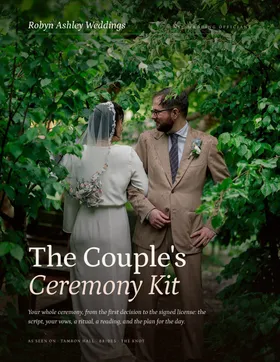
Walk in with a ceremony that sounds like the two of you
This post covers one part of the ceremony, and the Couple’s Ceremony Kit covers the rest, with five full scripts to start from and the prompts I use to help couples write their vows.
- Five full ceremony scripts in five different styles
- The Story Mine, thirty prompts for writing your vows
- Sixteen unity rituals, with the words and what to gather
- Thirty readings, each with my notes on when it fits
VOWS
How Long Should Wedding Vows Be? Word Counts, Minutes and Three Examples
A flexible length target, a words-to-minutes table, three example vows with estimated reading times, and what to do when one of you wrote twice as much.
READ →
VOWS
How to Start Your Wedding Vows (15 Opening Lines That Aren't 'From the Moment I Met You')
Fifteen first lines for your vows, each matched to the couple it suits, the four openers I'd retire, what to do in the first five seconds, and six ways to end.
READ →
VOWS
Wedding Vow Template: A Fill-In Structure for Your Own Words (and What to Include)
A copy-ready vow template with the question behind every blank, one filled-in example, what to include and leave out, and two other versions for couples who would rather repeat or share.
READ →